Catering Staff Management: Roles, Rates and Records That Prevent Event-Day Chaos
Mahipal, Founder, CaterCaptain · Jun 15, 2026 · 3 min read
The Idea Behind CaterCaptain
Most software for caterers is built far from any actual kitchen - global products that assume drop-off catering and card payments, or generic restaurant POS stretched over an industry it doesn't understand. We took the opposite bet: build deep for one place first. Here's the reasoning, openly.
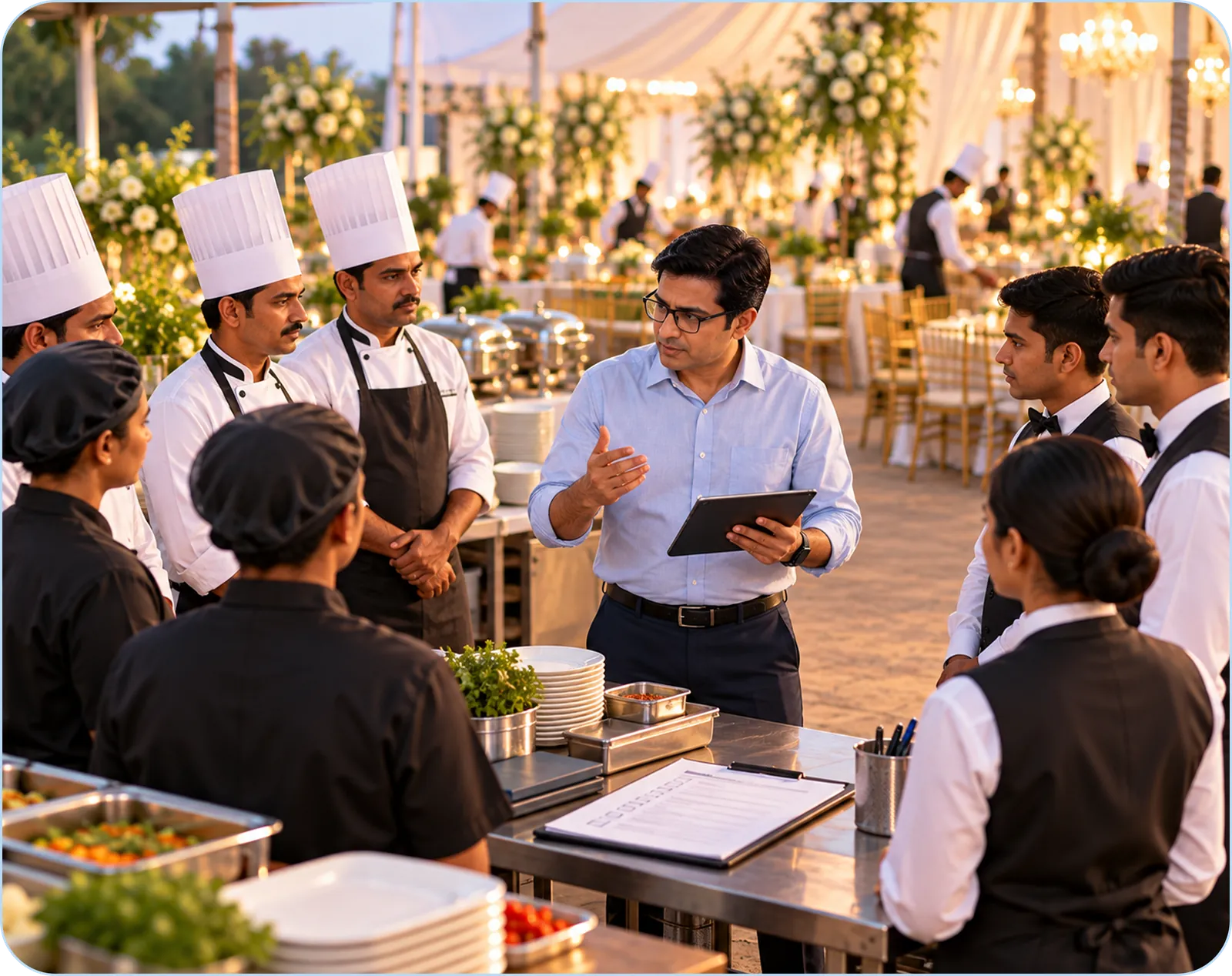
Food fails loudly, but staffing fails silently - a missing waiter shows up as slow service, a double-booked cook shows up as a 6 AM panic call. Staff management is the least glamorous system in catering and one of the most profitable to fix.
How many staff do you need per 100 catering guests?
For a standard served Gujarati function, working ratios look like:
- Cooks: 1 head cook + 1 cook per 120–150 plates for a multi-course menu
- Helpers: roughly 1.5× the cook count - prep, washing, running
- Service staff: 1 per 40–50 guests for buffet; 1 per 25–30 for table service
- Counter staff: 1–2 per live counter
- Supervisor/captain: 1 per venue kitchen, non-negotiable above 300 plates
These flex with menu complexity - a live pasta + chaat + jalebi setup consumes staff that a fixed buffet doesn't.
Rates: pay clearly, record clearly
Gujarat 2026 freelance ranges (vary by city and season): experienced cooks ₹1,200–₹2,500/day, helpers ₹600–₹1,000, service staff ₹700–₹1,200, head cooks and specialists above that. Whatever you pay, the record matters more than the rate: name, mobile, role, rate, rate type (per day/per event), event assigned. Disputes about "tame kidhu hatu ₹900" evaporate when the number was written at assignment time.
The double-booking trap
Peak season's classic failure: the same trusted cook verbally promised to two events on the same date. Root cause is always the same - assignments live in phone calls. The fix is one visible roster per date: every staff member, every event, one screen or one sheet. If two events claim the same person, you find out at planning time, not at 6 AM.
Attendance: proof beats memory
Freelance-heavy teams mean payment disputes are structural, not personal. Record arrival at the venue - even a simple check-in with time - and payments become arithmetic instead of negotiation. Your best staff will prefer working with you because the records are clean; reliable people like reliable systems.
Retention beats recruitment: paying last season's good staff 10% above market and confirming them early costs less than one event run with strangers hired at midnight rates.
Build the bench before you need it
Maintain a rated list - beyond names, note who's fast, who handles pressure, who no-shows. After each event, 60 seconds of notes per new hire builds a bench that makes season scaling boring. Boring is the goal.