Catering Quotation Format for India: What Every Quote Must Include (2026 Guide)
Mahipal, Founder, CaterCaptain · Jun 01, 2026 · 3 min read
The Idea Behind CaterCaptain
Most software for caterers is built far from any actual kitchen - global products that assume drop-off catering and card payments, or generic restaurant POS stretched over an industry it doesn't understand. We took the opposite bet: build deep for one place first. Here's the reasoning, openly.
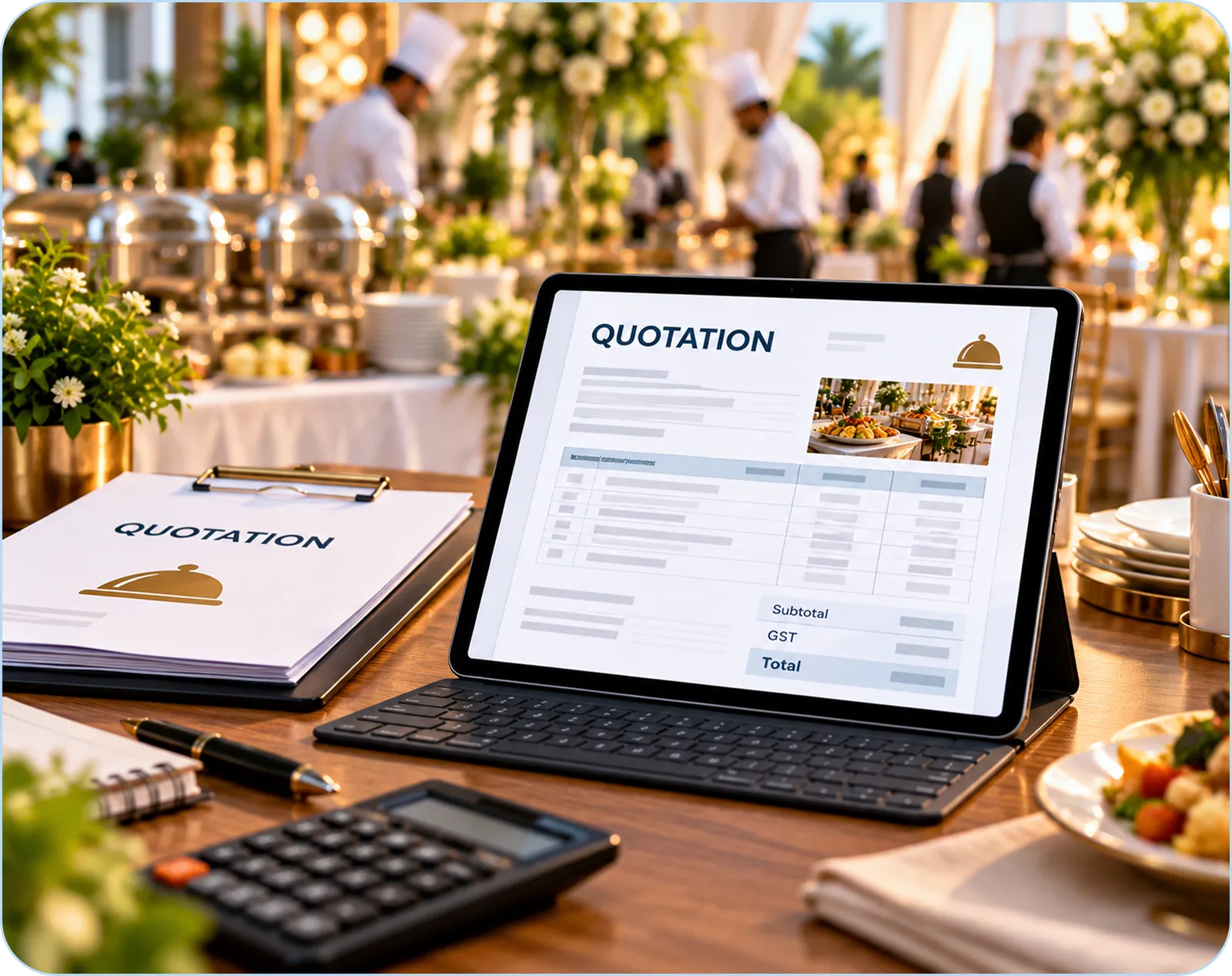
A quotation is the first document your client judges you by - before they taste a single dish. A messy Word file with inconsistent totals says "unorganised kitchen." A clean, itemised, GST-clear quotation says "this caterer runs a tight operation." Here is the exact structure that wins bookings in Gujarat and across India.
Related guide: How to Price a Catering Quotation in India: Per-Plate Cost, Margin and GST, Step by Step
What should a catering quotation include?
- Your business header - name, logo, address, phone, GSTIN. Clients forward quotations to family members who decide; your header travels with it.
- Client & event details - client name, event name, date(s), venue, and contact. Ambiguity here causes the classic "we thought you meant the reception, not the sangeet" disaster.
- Service-wise breakup - breakfast, lunch, dinner listed separately, each with its own guest count. A 3-day wedding is 6–9 services, not one line item.
- Menu summary per service - category-wise (starters, main course, sweets) with dish names. This is what the family circulates on WhatsApp.
- Per-plate rate × guest count - the calculation shown openly. Hidden math breeds negotiation; visible math breeds trust.
- Other costs - decoration, live counters, transport, service staff. Itemised, not buried inside the plate rate, so the plate rate stays comparable.
- GST - shown clearly at the applicable rate. Corporate and institutional clients will reject quotations without a proper tax line.
- Advance & payment terms - the standard Indian structure is 25–50% advance on confirmation, balance before or on event day. Put it in writing.
- Validity - 7 to 15 days. Ingredient prices move; an open-ended quote from March can bleed you in May.
Per-plate vs package pricing: which to quote
Per-plate works when guest counts are firm and the menu is standard. Package (lump-sum) pricing works for premium clients who want an experience, not a spreadsheet. Many successful Gujarat caterers quote per-plate for the main services and package the extras (welcome drinks, live counters, late-night snacks). Whichever you choose, be consistent within one quotation.
The three mistakes that lose bookings
Slow delivery. Families collect 3–4 quotations; the first professional one anchors the comparison. If yours takes three days, you're negotiating against an anchor someone else set.
No version control. The client asks for paneer instead of chicken, you send a revised quote, and now two versions float around WhatsApp. Number your revisions (Quotation #2, dated) and mark old ones superseded.
Round numbers that look like guesses. "₹4,50,000" reads like a guess. "₹4,42,800, rounded to ₹4,43,000" reads like arithmetic. Show the round-off - it signals precision while still giving a clean figure.
Speed matters most. Caterers who send quotations the same day the enquiry comes in convert dramatically better - not because the quote is cheaper, but because the family is still excited when it arrives.
Frequently asked
Should I show GST to non-corporate clients?
You can present the total inclusive of tax for families while keeping the tax line visible for those who ask. What you cannot do is invoice without proper GST if you're registered - the quotation and the final invoice must reconcile.
How detailed should the menu be?
Dish names, yes. Recipes and quantities, no - that's your plan sheet, an internal document. The quotation sells the experience; the plan sheet runs the kitchen.